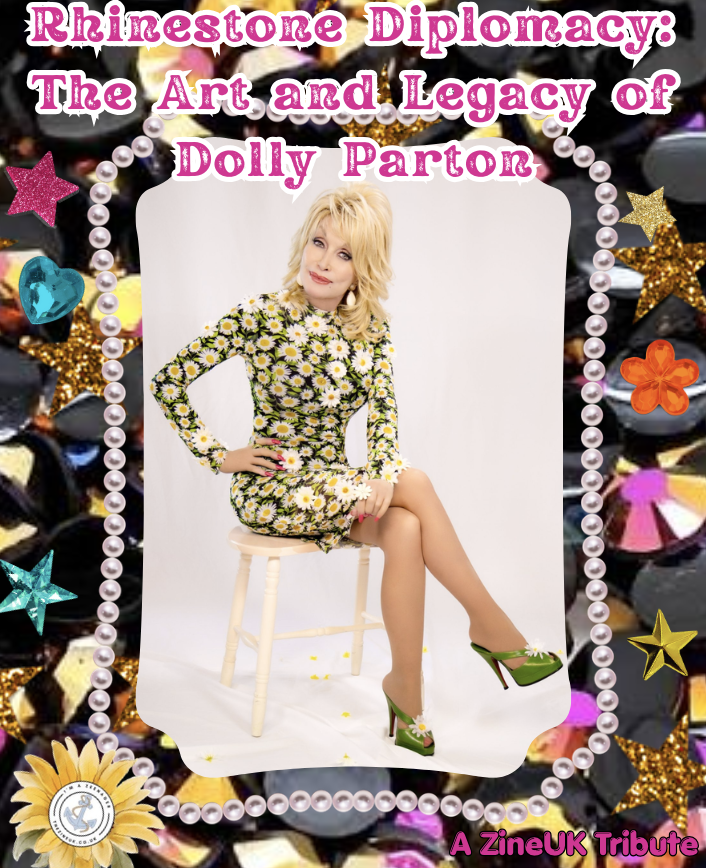
Rhinestone Diplomacy: The Art and Legacy of Dolly Parton
In a world split by algorithms and culture wars, Dolly Parton may have been the last person capable of bringing almost everyone together. Now that we're saying goodbye to the queen of rhinestones, it's worth asking whether anyone will ever occupy that strange, glittering territory again.
There was a particular magic to watching her at Glastonbury. Punks with safety pins, emos forgetting their troubles and mums clutching cider stood together, crying into sparkly cowboy hats while a woman in a gravity-defying wig sang about a raven-haired temptress. For a moment, the whole UK, and perhaps much of the world, seemed to pause.
Dolly could earn applause from both the Grand Ole Opry and a drag queen in West Hollywood. In a media culture built around conflict, that made her increasingly unusual.
Dolly Rebecca Parton wasn't merely a musician. She was a master of stage style.
At The Zine UK, we have always understood that clothes can be manifestos, shields and banners. Parton weaponised the "dumb blonde" stereotype, using rhinestones and exaggerated femininity to conceal just how shrewd she was. If people were distracted by the wig and the "jugs," they might underestimate the businesswoman who owned her publishing rights and famously rejected Elvis Presley's proposed recording of "I Will Always Love You" because his manager demanded half the rights.
She played the fool and became the queen.
These were more than punchlines. They were survival strategies.
When reporters asked about politics, she answered with Dollyisms.
She would smile, make everyone laugh and leave the original question behind.
Her Q Score, the industry measure of celebrity appeal, was reportedly among the highest in the world. A YouGov poll gave her a net approval rating of +65%, far beyond the ratings of contemporary presidents. A woman with acrylic nails and a towering wig outpolled the most powerful men in America.
That was stagestyle.
Parton also declined the Presidential Medal of Freedom from two presidents. She insisted that she did not want to appear partisan.
That position allowed her to remain a hero to the LGBTQ+ community while speaking openly about her Christian faith. She could be a feminist icon and a "Backwoods Barbie," although she preferred to call herself a "woman in business."
She turned neutrality into an art form.
To understand the unifier, you have to understand how she learned to leave without burning everything behind her.
Dolly wrote "I Will Always Love You" as a farewell to Porter Wagoner, the man who helped give her a national platform but also held her inside a suffocating professional arrangement.
She walked away with her songs and used them to build an empire. The businesswoman behind the blonde wig had arrived.
Decades later, Whitney Houston transformed that private farewell into one of the biggest recordings in popular music.
When Houston recorded "I Will Always Love You" for The Bodyguard in 1992, Parton allowed her to make it entirely her own. She did not demand a country arrangement or complain about the gospel flourishes, the vocal pyrotechnics or the key change.
She got paid, and she celebrated.
There was something revealing in that response. Parton understood the difference between owning a song and suffocating it. Whitney's version did not diminish Dolly's original. It expanded its life.
Parton later used her wealth to support projects such as the Imagination Library, which sends free books to children. A song written about leaving a controlling professional relationship became part of an extraordinary philanthropic legacy.
This was Dolly's politics: practical, quiet and resistant to spectacle. She rarely marched, shouted or issued grand declarations. She preferred to use the machinery available to her and redirect some of its rewards.
She made people feel welcome without asking them to pass an ideological test first. Punks, emos, drunken mums, communists, drag queens, evangelicals and Republicans could all find something recognisable in her.
That was Uniqulture.
Dolly loved the gays, and the gays loved her back.
Anyone who has spent time at drag shows knows the scale of her influence. I have seen Dolly tribute acts ranging from wonky wigs and bargain-bin rhinestones to transformations that must have cost a month's rent. All of them channel the same conviction: I am who I am, and I intend to look fabulous.
She understood the power of artifice as authenticity. The hair, nails, costumes and impossible proportions did not conceal her real self. They expressed it.
Her support for LGBTQ+ people was usually delivered without ceremony.
Her 1991 song "Family" called for tolerance at a time when the AIDS crisis was devastating queer communities and country music remained deeply hostile to open discussions of queerness.
When controversy surrounded unofficial "Gay Days" at Dollywood, she refused to abandon the people who attended. Her answer was characteristically simple:
That consistency mattered. She represented the courage to become more fully yourself in a world that often wants you quieter, smaller and easier to classify.
She even once entered a Dolly Parton drag queen look-alike contest and lost.
Only Dolly could lose a Dolly Parton contest and emerge even more convincingly herself. She understood the joke and never mistook dignity for solemnity.
Dolly was Miley Cyrus's fairy godmother. Billy Ray Cyrus, her friend from their touring days, asked her to take on the role when Miley was born.
In another sense, Dolly seemed to belong to everyone. She felt like an auntie, a fairy godmother or a glamorous friend who would fix your lipstick, hand you a drink and tell you to try again.
For many people, her songs are tied to family memories. "Coat of Many Colours" recalls kitchens, mothers, Sunday roasts and radios crackling in the background. The music carries the feeling of being looked after.
That emotional familiarity helps explain why she crossed so many cultural boundaries. She did not feel remote, even when dressed like a rhinestone-covered hallucination.
Dolly insisted she was not political.
Yet her actions had political consequences.
During the pandemic, she donated $1 million to Vanderbilt University Medical Center, supporting early research connected to the Moderna COVID-19 vaccine. While public figures argued about masks and mandates, Parton put money into medical research.
The Imagination Library was similarly direct. Established in 1995 as a tribute to her father, who could not read, the programme has distributed hundreds of millions of books to children.
She also donated to relief efforts after tornadoes struck Tennessee in 2020.
This became her familiar method: identify a problem, fund something practical and return to work. The contrast with the carefully staged benevolence of influencer culture could hardly be sharper. Dolly's philanthropy was public, but it rarely appeared designed around her own moral performance.
She used fame as infrastructure.
Dollywood may be the clearest physical expression of her worldview.
The park draws evangelicals, bikers, drag queens, families and pensioners into the same queues. There is no personalised feed or ideological filter. People simply coexist, eating cinnamon bread and waiting for roller coasters.
In an age of algorithmic sorting, that feels almost utopian.
I have never been, but I understand the appeal of a place where a drag queen and a Bible Belt grandmother can stand beside each other without being turned into opposing content categories.
No echo chamber. No discourse. Just fried pickles and "Jolene" on a loop.
The response to her death demonstrated the scale of her cultural reach.
In left-wing corners of social media, accounts more accustomed to posting theory and ratio-ing landlords shared "9 to 5" memes. The song, written for a Lily Tomlin film, had long since become an anthem for anyone exhausted by work, exploitation and barely getting by.
Communist accounts called Dolly "our comrade in rhinestones" and paired her image with "seize the means of production, honey." The posts were jokes, but not entirely.
Dolly had not set out to write a Marxist anthem. She had set out to write a banger. Somehow, she accomplished both.
From the other side came tributes from Donald Trump, who ordered flags lowered and called her "a truly special woman," despite Parton having declined his offer of the Presidential Medal of Freedom.
That contrast would have seemed ludicrous with almost any other celebrity. Tankies posted Dolly memes while the machinery of the American state honoured a country singer from Tennessee. Between them were drag queens staging tributes, punks shouting "Jolene," Nashville bars playing her back catalogue and ordinary people remembering where they were when they first heard her songs.
Yesterday, I scrolled through my feed and saw people who had spent years screaming at one another about Brexit, Trump and vaccines briefly agree on something.
A woman with big hair and a bigger heart had united them.
It was beautiful, absurd and probably unrepeatable.
Both Trump and Harris called her an "American icon."
Few contemporary celebrities could receive that description from both sides without one audience revolting. Taylor Swift provokes partisan fury. Beyoncé polarises. Bruce Springsteen is either too elite or too blue-collar, depending on who is complaining. Even Keanu Reeves has detractors.
Dolly was harder to reject because she could not be reduced to one constituency.
The left heard class consciousness in "9 to 5" and saw solidarity in the Imagination Library. The right recognised Christian faith, rural roots and country authenticity. Queer audiences saw a queen who loved them back. Others saw a woman devoted to her husband for nearly 60 years.
Everyone found a version of Dolly they could claim. None of those versions fully contained her.
Dolly never rejected where she came from. She leaned into the hillbilly stereotype so completely that it lost its power to humiliate her.
She did not run from the holler. She built a castle there.
Many of us spend our lives trying to escape our origins, smoothing out our accents and hiding whatever might mark us as unsophisticated. Dolly moved in the opposite direction. Her background became material, identity and strength.
She made "Backwoods Barbie" sound like a royal title.
Her husband, Carl Dean, avoided the spotlight for six decades. He rarely attended awards ceremonies or gave interviews, and Dolly respected that privacy.
In an industry where relationships often become promotional campaigns, theirs remained largely their own. He occupied the background while she occupied almost every inch of the stage.
His death in 2025 ended a marriage of nearly 60 years. There is painful symmetry in their deaths arriving so close together. Behind the public grief for an icon was the private grief of a woman who had lost her partner.
"9 to 5" was not conceived as a political manifesto. Dolly discovered its rhythm by tapping her acrylic nails together during filming.
Yet it became a labour anthem, a feminist rallying cry and, eventually, a Marxist meme.
That was one of her gifts. The politics emerged from the specificity of the song rather than being imposed upon it. She wrote about exhaustion, poverty, heartbreak, suicide and miscarriage because she understood pain. Then she wrapped those stories in choruses people wanted to sing.
Her joy never erased the sadness. The sadness never cancelled the joy.
Dolly's refusal to join partisan politics was essential to her appeal, but it also imposed limits.
She did not use her platform as Nina Simone or Bob Dylan did. She rarely endorsed candidates, marched or named political enemies. She united people by making room for their differences, not by asking them to confront those differences.
She was a diplomat rather than a revolutionary. Diplomats broker peace; they do not usually dismantle the systems producing the conflict.
Dolly asked people to sing together. She did not always ask what would happen after the song ended.
Her universal appeal was also shaped by race. She was a white Southern woman working in a genre historically associated with conservatism and Confederate imagery. She could be embraced by white America without appearing threatening.
Although she supported Black artists, funded literacy programmes and expressed love for marginalised communities, she rarely spoke directly about structural racism. She performed alongside artists whose politics and imagery deserved confrontation, but did not publicly confront them.
That does not erase what she achieved. It defines its boundaries.
The same tension applies to her philosophy of action over words. She funded vaccine research without attacking anti-vaccine activists. She gave books to children without naming the politicians cutting education budgets. She supported LGBTQ+ people without directly confronting every evangelical organisation campaigning against them.
Perhaps she understood that naming enemies would destroy her ability to reach their audiences. That may have been a wise calculation, but it was still a calculation with costs.
She worked within the system and made parts of it kinder. She did not overturn it.
Perhaps the answer lies in her playbook.
Rhinestones as armour. Kindness as rebellion. Books instead of battles.
She knew poverty, illiteracy and professional control. When she gained power, she used it to give other people choices she had once lacked.
That statement sounds modest, but making people feel seen, safe and welcome is not a small achievement.
Dolly Parton's death has exposed something uncomfortable about the present.
We are atomised by algorithmic feeds, ideological silos and media systems that reward outrage. The conditions that helped produce a figure with Dolly's reach are disappearing. Shared cultural experiences have been replaced by personalised feeds that show us what we already believe and encourage us to despise everyone outside them.
Dolly resisted classification. She was a crossover artist in an era increasingly defined by crossfire. Her contradictions were not flaws to be corrected by a personal brand manager. They were the source of her appeal.
She may have been the last unicorn.
Perhaps no one will replace her. Perhaps we should not expect anyone to. The next figure capable of bringing people together may look nothing like Dolly Parton.
For now, we can mourn her, raise a glass of something cheap and bubbly, and sing "Jolene" at the top of our lungs.
If you'll excuse me, I have rhinestones to glue onto my jacket.
The bigger the hair, the closer to God. Right now, I need to be closer than ever.