Dismantling the Fashion Industry: Analysing Class, Capitalism, Colonialism, and Cultural Oppression
Fashion is an omnipresent force in our lives, whether it is viewed as art to be admired or something that is functional which does not require much thought beyond said function. However, no matter how it is viewed, everyone partakes in fashion; whether that is consciously or subconsciously. Fashion has been viewed as something that has been aspirational for centuries. Sewell (2010) puts forward the argument that 17th century France was the epicentre of fashion, especially within Europe and “flatters the vanity of the rich” by the 18th century the idea of fashion moved beyond the rich; and with this consumption of fashion we see the precursor to the rise of capitalism that came with the industrial revolution.
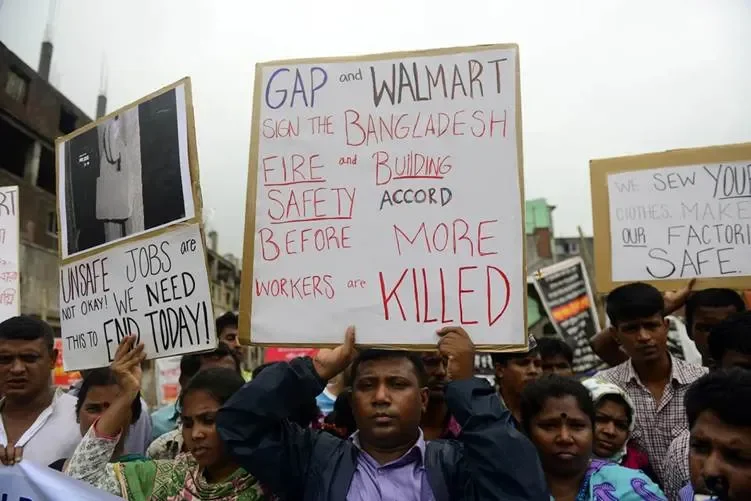
With this rise of capitalism fashion became violence and remains as such. The hands are stained with the blood of those the industry so willingly sacrificed, from the charred corpses throughout history to those who are crushed when the already shaky foundations can no longer bear the weight. Wei (2022) states that research within fashion is categorised into four major categories when it comes to discussion: race, ethnicity, body types, and gender. Whereas the aim of this literature review is to expose how capitalism, colonialism and globalisation, and consequently exploitation and violence are the catalysts for the previously stated issues within the fashion industry and how it can be dismantled, not just reformed.
Kawamura (2020, p25) describes fashion as something that needs to be studied empirically due to the abundance of “non-academic information about fashion in our everyday life”, with fashion being based around assumptions and untested hypotheses. For this report I decided to use both a survey and interviewed people from different backgrounds as my primary research to gain a wider understanding of how people viewed fashion and what they perceived to be problems within the industry, and using the most common themes from my primary research as the basis for the discussion and analysis while using the contextual research to explore how it is all intertwined.
Environmental Impact
Fashion has had a substantial impact on the environment, and this has been the source of conversation around consumers. Within in my survey concern for the environment was expressed by many people when asked about the issues/problems linked to the fashion industry, with one person (who shall be called participant 1) even commenting on the water usage.
During the email interview, with participant that I shall call “G”, who is an activist and former clothing brand owner, when asked about if fashion causes the most harm under the current societal structure, she speaks about how “the industry is built up of the ruling class and encourages hyper-individualism”, and as result consumers “put convenience over humans rights and environmental safety”. She also speaks about how both environmental harm and worker exploitation go hand in hand; and this stems from a system that puts profit first. The Bhopal gas disaster in 1984, supports what “G” stated in her interview, with the Union Carbide plant producing pesticides, these pesticides as Hoskins (2022, p.136) points out, they were used for the production of cotton in the USA. The United Nations (2024) call Bhopal a sacrifice zone due to the pollution and contamination of the drinking water and soils, something that affects 71 villages, or over 200,000 people; and that alone is not including the 570,000 people who were initially exposed to it, which resulted in 10,000 deaths after three days and over 20,000 since then.
The Aral Sea, in Uzbekistan being drained since 1977 highlights the environmental damage also caused by the production of cotton, numbers are not consistent when researching the amount of water used for cotton; however, the WWF (2007) reports that it is 8506 litres of water to create 1kg of cotton, and as a result pollutes or drains water supplies. This also strengthens what both ‘participant 1’ and ‘G’ commented on in terms of the environment.
As discussed earlier, Ghana have become over dependent on the West’s discarded clothes, which is a result of the West’s overconsumption especially relating to fast fashion; the findings in my survey found that people are aware of the effects of the overconsumption and fast fashion, with ‘participant 1’ stating that it reflects society’s need for instant gratification and links it to capitalist pressure to buy and disregard, while also saying the pursuit of profit comes at the cost of the planet. Participant 2 echoes participant 1 concerns while discussing how cheap fabrics and clothes contribute to fast fashion waste, but also environmental contamination. Participant 2 also discusses the idea that companies like ‘Vinted’ is a backlash towards consumer waste and brands such as ‘Shein’. Mulkey (2024) supports these ideas after reporting ‘Shein’ being the biggest polluter in fast fashion, beating out brands such as H&M, and Zara. This is linked to use of AI which “enables fast fashion to become the ultra-fast fashion industry” and is already catastrophic to the environment, textile waste, and microplastic pollution. Kent (2025) also reported that Shein is once again one of the biggest polluters, with the carbon emissions being a main reason why.
The environmental damage caused by the fashion industry can be considered a form of colonialism if Barber’s definition (2021, pp.35-36) is applied due to these companies using and destroying the resources of previously colonised countries, and using “G’s” perspective, it goes in hand with wanting profit.
Beauty Standards and (the Lack of) Diversity
Beauty standards can encompass many things but often plays a role within the fashion industry with Dorkenoo (2023) stating that the fashion industry sets the unrealistic body standards. The beauty standards within the fashion industry was a topic that had the most concern expressed about within my survey. Participant 1 explains when asked about whether the fashion industry reflects the issues of society that fashion mirrors a culture obsessed with instant gratification and the cycle of buying and discarding fuels unrealistic body standards due to “a narrow definition of worth tied to appearance...”. Participant 3 strengthens participant 1’s argument by saying that one of the issues closest to them was size inclusivity as they never fit the beauty standard, they go on to say that plus size fashion costs more because of the use of “more fabric”. Participants 4 and 5 both discuss the lack of diversity within the fashion industry, especially surrounding POC (people of colour); with participant 5 stating that body types are seen as a fashion trend, which also leads to racism and other discrimination.
Analysing the idea of racism within the fashion industry and subsequently the beauty standards that are promoted to the consumer, it plays out in ways where POC are seen as commodities or gimmicks. Alek Wek when walking for Betsy Johnson in 1998, threw off the blonde wig she was wearing, and in McDonald’s article Hair Story: Alek Wek (2016) she discusses how “that moment has become a literal symbol of rebelling against a European standard of beauty” while also speaking about how Alek Wek refused to be a gimmick within fashion.
Interviewee participant “D” who is a political activist, ARAF (Anti-Racist, Anti-Fascist) chairwoman, and activist within the Roma community, she spoke about how she views fashion is used as a way to control and distract the population, and with the vanity of fashion the beauty standards come into play which consequently encourages such things as disordered eating to obtain that beauty standard. Lindo (2025) discusses further the idea of colonialism in beauty through the lens of beauty pageants in Jamaica and how in 1929 white people dominated the pageants. She goes onto state that the winners were representative of colonialism due to the favouring of whiteness “and showcased the lighter natural features that were deemed to be an ideal of beauty”. Tate (2010) also echoes this with the quote “‘Black women want to be white’ because white beauty is iconic.” and traces the origins of these ideals back to imperialism, slavery, and postcolonial dependency with the idea of whiteness being more civilised.
Eviota (2023), comments on the media coverage of fashion from both fashion shows and advertising campaigns being mainly fronted by white, skinny models which excludes POC, especially women, potentially leaving them “disorientated” as they try to navigate their own identities. She then goes onto state that tokenism is what is helping the industry appear more diverse to seem more inclusive. “G” also states that one way she would want the fashion industry to change would be for it to be a tool so people can communicate who they are instead of the companies building it up to make a profit off insecurity that comes with the aforementioned.
Cultural Identity
Within my interviews cultural identity was a topic that was examined through different lenses. “S”, who is a fashion student, speaks about the idea of collaboration that has been a result of colonialism, meanwhile “D” as previously mentioned, speaks about her identity as a Roma woman, and “J”, a volunteer in a community hub, whose focus is on working with the local community, and providing for those in need, he tackled this from the perspective of subcultures and what fashion means to those who he meets within the hub.
Analysing “J’s” interview first, he describes fashion as something that’s “all in the mind” and that it serves the purpose of standing out (something that has been acknowledged by “G” too). He also goes onto say that fashion is used as an identity marker for groups of people and their interests, whether it’s football, or music being the two that he mentioned. He also acknowledges different subcultures. When asked about the people who he meets, he states that most of the time these people have no interest in fashion as due to living circumstances, they need it to be practical.
With ‘D’s’ interview, she speaks about how she would change the industry through a non-tokenistic way and amplify the voices of indigenous people. One reason being that she sees her culture as a Roma woman being taken away from her, then sold back to her at prices she cannot afford. She references this being through the boho chic aesthetic and because of the popularisation of this aesthetic it has made her culture feel commodified, resulting in her feeling like she’s unable to dress in her culture’s clothes because it plays into a stereotype and feels like a costume.
Subcultures, particularly those that have political (punk and goth for example) or cultural roots from outside the Western cultures have been commodified, “D” explains this with boho chic and her culture; but Zarif (2025) discusses how capitalism has caused the downfall of subcultures. He defines subcultures as a social movement that challenges the social norm. Zarif (2025) also discusses the aestheticisation of such looks meant it appealed to the masses and with this appeal, fast fashion companies saw opportunity to make a profit; stripping away the cultural meaning of these (sub)cultures.
“S” expressed a slightly different view from “D” by stating that the impact that colonisation has had on fashion has been negative overall, but the benefits have been that it has given people the opportunity to create more ideas, with fashion holding the space for society to express its creativity. “G” echoes the idea that fashion is a space to be able to express oneself creatively, but further mentions the idea that fashion is inherently political and should be used as way to create community. Barnard (2020) comments on the idea that fashion has become a “one style suits all” while using Tommy Hilfiger as an example, due to globalisation; this highlights where my interviewees and survey participants feel like fashion is currently at within society and Zarif (2025) further supports this with his discussion about how capitalism uses fashion and popular aesthetics to create profit.
Summary
Despite people viewing fashion as very different things, people have similar views when discussing the problems within the industry; but even with that not everyone agrees that fashion is inherently political or a reflection on society with participant 6 in my survey discussing that they view fashion as something that is for elite therefore is not a reflection, and participant 7 expressing the idea that fashion should be something that should be kept separate from society and societal issues. However, a criticism for that due to fashion’s relationship with capitalism, as pointed out by Sewell (2010) and Briggs (2013, p.186), it is nearly impossible to do so, and even the topics as previously discussed do not exist in a vacuum, they are consequences of capitalism and colonialism.
Conclusion
Dismantling the fashion industry would be an arduous task, one that cannot be done without real change within society. I continue to uphold the idea that the industry cannot be reformed due to how the industry is built on the exploitation of workers, as argued by Karim (2014) which also supports Marx’s (1961, pp.176, 178) theory of capitalism; which is a form of colonialism, something that Barber (2021, pp.35-36) argues within her definition of capitalism and Barnard (2020) expands upon with the idea that globalisation is a form of colonialisation as both seek dominance over one set of people by another, and in this context it is through fashion and culture. People are wanting to see change, and with both “S” and “G” they want to see an industry that is more community based and localised, “D” wants to see an industry that takes away the elitism and the “MET Galafication” of fashion in order to make it more accessible, and finally “J” wants to see an industry that comes back to the UK and create opportunities for those who are qualified, as well as opportunity to start a business that is sustainable in an economic sense. Prior to the industrial revolution the fashion industry was “a cottage industry” as stated by clothing brand Carr & Westley (2022), and despite Selway (2010) discussing that fashion was for the elite during this era, people now want to feel connected to what they wear and what they want to convey.
Recommendations
Using the ideas and wants of my participants and interviewees, in order to start dismantling the fashion industry there needs to be the focus on the local communities which can lead to something bigger.
The first idea is to educate oneself on the industry through both reading and documentaries. “The Anticapitalist Book of Fashion” by Tansy Hoskins (2022) is a book that encompasses everything that has been discussed and can be considered a starting point before doing deeper research. Bel Jacobs’ blog is another example due to her relationship with the fashion industry as she quit her job as the fashion editor of the Metro after the Rana Plaza collapse to become an activist. In 2008, the BBC released a documentary called “Blood, Sweat, and T-shirts” where fashion lovers (which included now TV presenter Stacey Dooley) were sent to India to educate them on how their clothes are made.
Secondly, amplifying the voices of those who need their voices to be amplified. Within activism circles, people want to do the right thing hence why they are activists; however, at times the activists voices become louder than those of who need their voices to be heard which is why it is important to listen and amplify.
Finally, as a personal protection to oneself: join a union. This means that there is legal protection if needed, and it stops the exploitation of you, the worker. Some examples are USDAW being the main one for retail workers, Labour Behind the Label for garment workers globally, and Bectu Fashion UK to help creatives and freelancers. If there is a feeling of being unable to join a union due to being unsure about where you fall within the industry, unionise with colleagues/peers to create momentum and a movement.
This is a abridged version of Ruby’s University Dissertation.
To read it in full and to see References available here: https://rubyblue007.substack.com/p/dismantling-the-fashion-industry