Ruby Blue's Red Flags: How the Industry Props Up Subpar Artists at Women's Expense
"It must be nice to be a man and make boring music just because you can"
These are the words echoed by Florence Welch in her new single 'One of the Greats'.
Whilst this piece isn't about her specifically, these words capture what every woman feels, not just in the music industry. As a society, we consistently prop up and idolise male mediocrity, usually at the cost of the women who support them.
The creative industries are amongst the guiltiest when it comes to celebrating subpar male performance. They push the idea that what they're offering is something new, exciting, and sometimes even revolutionary. A consequence of this is inflated ego and entitlement amongst male artists.
The music industry particularly reflects how mediocre male performance is celebrated and supported, even at these artists' worst moments. According to UK Music's 2023 Diversity Report, women make up only 17.1% of songwriters and 21.7% of performers signed to major labels, despite representing roughly half of music graduates. This pattern often becomes a focal point when discussing industry inequality. This reality leaves us with two critical questions: "How is this harmful?" and "Where does this leave us?"
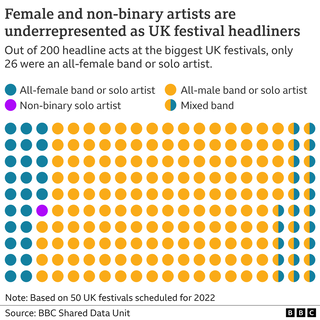
Music festivals: Only 13% of UK headliners in 2022 are female.
The Harm of Unconditional Support
The first question has a clear answer. This celebration creates dangerous ego and entitlement amongst male artists. They begin believing they're better than they are, because of unconditional support. They're told everyone loves them or will love them, and they deserve whatever opportunities are handed to them.
This system isn't sustainable. When reality doesn't match what they've been told, it comes crashing down—often as a consequence of their own actions. They lash out and push the narrative that they're victims, claiming the music industry is conspiring against them.
This manifests in attacks on promoters who "aren't doing their job properly" and music journalists who don't write about them enough. These artists expect industry professionals to flock to them. They sit about waiting for opportunities to fall in their lap instead of creating them. When they do make efforts, they often lack the follow-through to make things happen.
The Burden on Fans
The responsibility for these men's overselling then falls onto fans' shoulders, who are expected to support them regardless. During a cost-of-living crisis, with UK inflation affecting household budgets and concert ticket prices rising by an average of 23% since 2019, this expectation is not only tone-deaf - it's not fans' responsibility to clean up the mess.
These combined factors create impossible standards that become self-fulfilling prophecies. Who wants to work with someone who openly admits disdain for their profession? Who wants to support a band that guilt-trips fans because their support isn't considered enough? What fan wants to listen to artists who complain about hating to play their hometown because no one turns up? Who supports bands that don't put in work beyond making music and performing, then moan about seeing "the same ten faces"? After that behaviour, it'll probably be the same nine faces at most.
Women's Uphill Battle
Meanwhile, women in the music industry must work exponentially harder to be taken seriously. Whether doing everything behind the scenes and giving everything to bands that will ultimately prove ungrateful, or performing in bands themselves, women face additional barriers.
Female performers regularly speak out against sexualisation they face because men feel entitled to their time and space. A 2022 study by Help Musicians UK found that 85% of women in music have experienced sexual harassment, compared to 38% of men. Many women report how men physically grab them, act overfamiliar, and make them uncomfortable, behaviour that is often documented in photos these men proudly post online. These same men offer unsolicited opinions they would never dare give male artists because they respect those men too much.
When rejected or ignored, these men turn on the women they claimed to support. Again, they feel entitled to women's time and space.
Industry Context and Recurring Patterns
I want to acknowledge that the music industry is struggling financially. The UK live music sector lost an estimated £900 million during the pandemic, and venue closures continue to affect grassroots music. Unless significant investment already exists, it's not an easy business to enter, it is, ultimately, a business. Many articles have addressed this crisis, and many more will follow.
I've chosen to focus on this aspect not only because of recent events showing that mediocre male artists will be celebrated regardless of their behaviour. I've also noticed a recurring pattern: these men repeatedly shoot themselves in the foot, then wonder why they can no longer walk.
Where This Leaves Us
This brings us to our second question: "Where does this leave us?"
Unfortunately, this question lacks an easy answer. We can observe the fallout when things go wrong. We can try to remain honest as spectators. But unless fundamental changes occur—not just in the music industry, but in society's broader attitudes—we'll remain trapped in an infinite loop.
We'll continue seeing bands that appear to be on the right track, only to self-sabotage because they aren't receiving the unconditional support that they believe they deserve. Meanwhile, talented women will continue working twice as hard for half the recognition, supporting an industry that consistently undervalues their contributions.
The solution requires recognising that true artistic merit shouldn't be determined by gender, and that sustainable success comes from genuine talent, hard work, and respect for collaborators and fans, not from entitlement and inflated ego. Until this changes, the cycle will continue, and the industry will keep losing the very people who could help it thrive.
Ruby Blue is one half of the Chaos Twins alongside Editor Dizzy, bass player for Weather Underground, fashion student extraordinaire, and punk rock's answer to Indiana Jones. Known for her wonderfully infectious enthusiasm (unless you happen to be a mediocre indie band).