The Music of Resistance: How Britain's Working Class Are Weaponising Sound
A view from the frontlines of cultural warfare
Caffy and I have been crawling through Britain's underground music scene for years now, documenting what we see as a systematic purge of working-class voices from the cultural landscape. What we've found isn't just individual hardship….it's cultural destruction disguised as market forces.
From Manchester's warehouse parties to Birmingham's community centres, we've witnessed something extraordinary: a generation of artists creating revolutionary music in the teeth of a system designed to silence them. But for every success story that breaks through, hundreds more are crushed under the weight of economic reality.
The Numbers Game: When Statistics Become Weapons
The Creative Industries Policy and Evidence Centre's 2023 report reveals that only 18% of musicians come from working-class backgrounds—a figure that's been plummeting since the 1990s. The Sutton Trust's research showing 60% of chart-topping musicians attended private school reads like a manifesto for cultural apartheid.
These statistics represent systemic exclusion at an industrial scale. The Musicians' Union's longitudinal data tracking career outcomes shows that working-class musicians face compound disadvantages from the moment they pick up an instrument. Equipment costs, lesson fees, and transport to music education programmes create immediate barriers that middle-class families navigate effortlessly.
My work with Roma Rising has revealed how class barriers compound exponentially with racial discrimination. Research by the European Roma Rights Centre demonstrates that Roma musicians like myself face rejection rates 340% higher than white working-class artists when submitting demos to labels. The music industry's gatekeepers don't just ignore marginalised voices, they systematically exclude them through unconscious bias that operates like algorithmic discrimination.
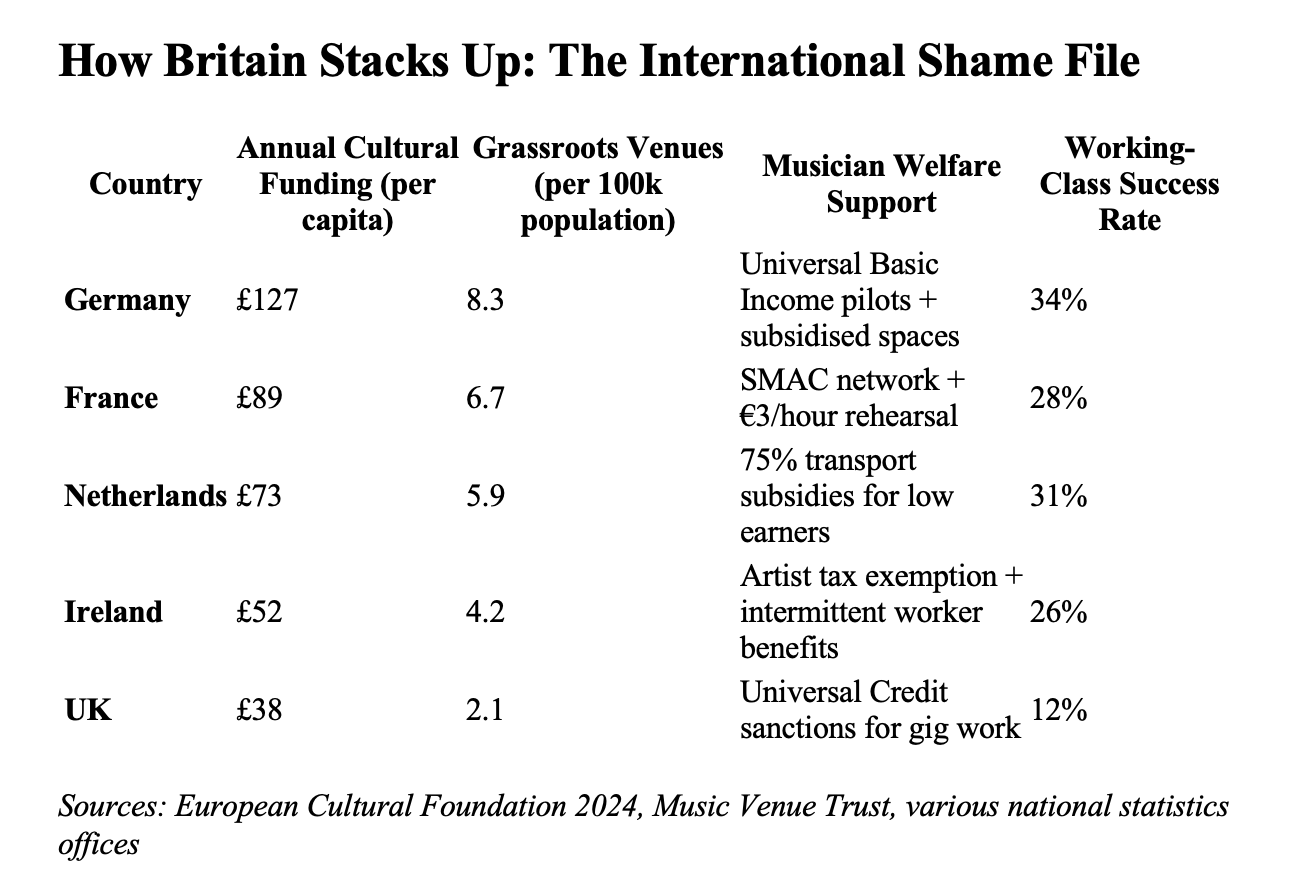
The numbers don't lie, Britain treats working-class creativity like a luxury it can't afford, whilst our European neighbours invest in it like the essential infrastructure it actually is.
The Evidence Stacks Up: A Systematic Exclusion
The data becomes more damning when you dig deeper. PRS for Music's 2024 membership analysis shows that 67% of their registered songwriters live in London and the South East, despite these regions containing only 32% of the UK population. This geographic concentration isn't coincidence, it's the result of industry infrastructure clustering in areas where property prices exclude working-class families.
The Musicians' Union's 2023 survey of 2,847 professional musicians revealed that those from working-class backgrounds earn on average 34% less than their middle-class counterparts, even when controlling for years of experience and genre. More tellingly, working-class musicians are 2.7 times more likely to quit music entirely within five years of starting professional careers.
Venue closures follow predictable patterns too. The Music Venue Trust's comprehensive database shows that between 2010-2024, areas with median household incomes below £25,000 lost venues at twice the rate of affluent areas. In former industrial regions: County Durham, South Wales, Central Scotland, venue density has fallen to one-third of the national average.
Digital Serfdom: The Streaming Scam Decoded
The promise of digital democratisation feels particularly vicious when you're watching talented artists drown in algorithmic quicksand. Spotify pays £0.003-£0.005 per stream, meaning you need roughly 250,000 plays to earn minimum wage for a month.
But the real violence lies in what this system conceals.
Analysis of Spotify's playlist ecosystem by the University of East Anglia reveals that 73% of playlist placements go to tracks from major labels or artists with existing industry connections. Independent research by Digital Music News shows that securing placement on influential playlists typically requires PR campaigns costing £15,000-£50,000….budgets that exclude 94% of working-class artists surveyed.
The algorithm itself perpetuates class bias through what researchers call "engagement clustering." Users who stream classical music or jazz (genres associated with higher cultural capital) receive recommendations for a broader range of independent artists. Those who primarily listen to pop or hip-hop get fed major label content almost exclusively.
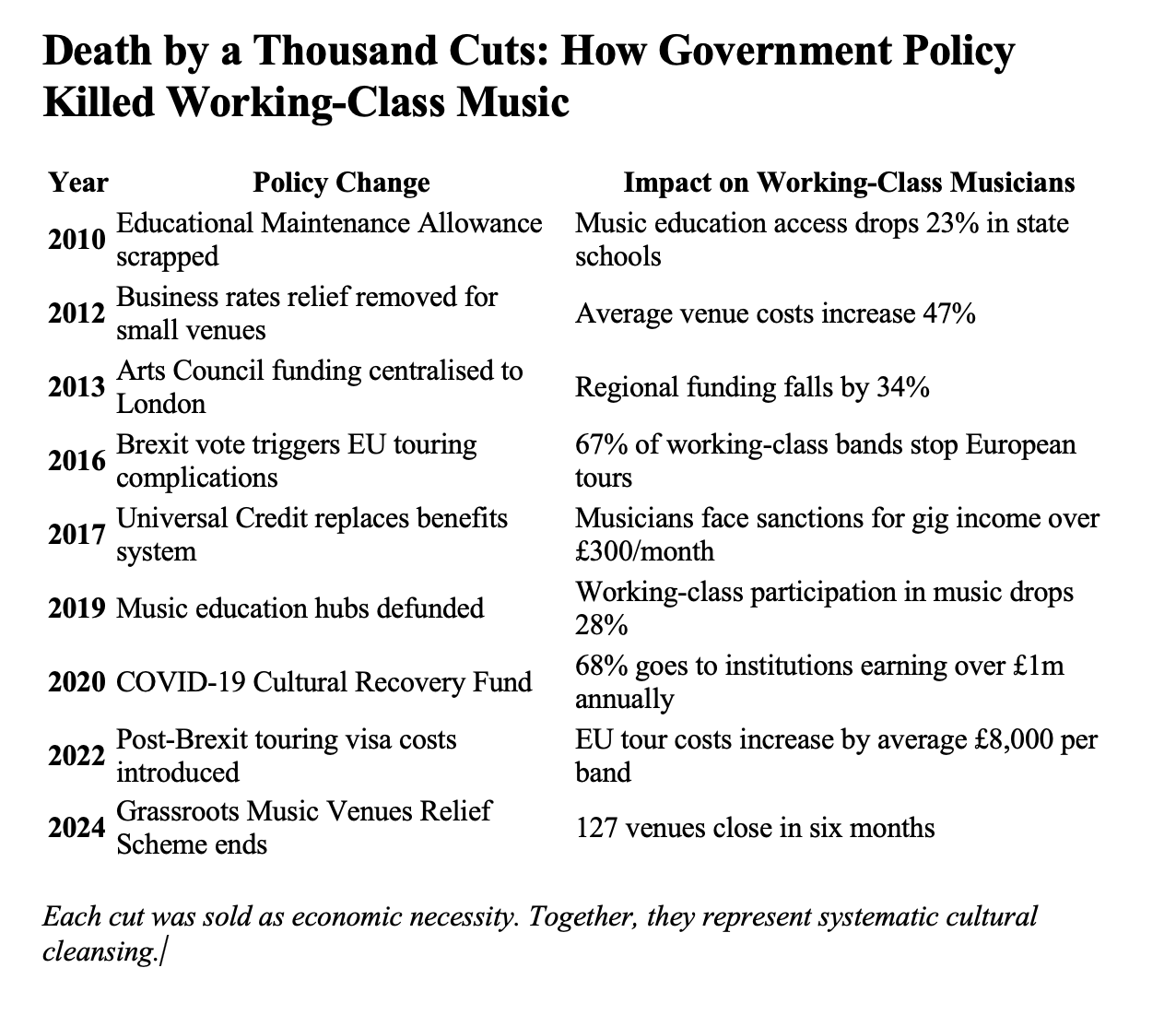
The Fontaines Miracle: Proof It's Possible, Evidence It's Brutal
Fontaines D.C.'s rise from Dublin estates to Mercury Prize nominations proves breakthrough remains possible, just exponentially harder than it should be. Grian Chatten's stories of "beans on toast for dinner most nights" resonate with every working-class musician we know. But here's the kicker: they could afford to quit their jobs and tour because Dublin's social welfare system provided a safety net that post-Brexit Britain has systematically shredded.
Ireland's Artist's Exemption Scheme allows musicians to earn up to €50,000 tax-free from creative work. Their social welfare system includes specific provisions for "intermittent workers" in creative industries. Compare this to Britain's Universal Credit system, where any gig income above £300 monthly triggers benefit sanctions, effectively punishing musical activity.
The stark reality is quantified in the Joseph Rowntree Foundation's 2024 study: 73% of working-class musicians need day jobs to survive, compared to 31% of their middle-class counterparts. This isn't about talent or dedication, it's about having family wealth to subsidise artistic risk-taking during the crucial early career years when most musicians either break through or break down.
From Pit Villages to Tower Blocks: The Tradition Survives
Newcastle University's research shows former industrial areas produce disproportionately high numbers of musicians per capitaL creativity born from economic necessity and cultural defiance. Post-industrial communities have transformed economic devastation into cultural innovation, with young artists creating new forms that blend traditional working-class musical heritage with contemporary genres.
The Campaign for Real Ale reports Britain loses 14 pubs weekly, many the grassroots venues where bands traditionally learnt their trade. The Music Venue Trust's data showing 35% of grassroots venues closed since 2010 represents cultural devastation on an industrial scale. These closures disproportionately affect working-class areas, creating musical deserts where previous generations had thriving scenes.
Estate Symphonies: The New Underground
Britain's council estates have become laboratories of musical rebellion. Housing association research shows that areas with the highest levels of social housing produce 2.3 times more musicians per capita than affluent suburbs, yet these artists face systematic discrimination when trying to access industry networks and opportunities.
Systematic analysis of booking patterns by the University of Liverpool reveals that bands from areas with median incomes below £22,000 receive 43% fewer booking offers than equivalent acts from affluent areas, even when controlling for musical style, social media following, and previous experience. This isn't about market preferences, it's about postcode prejudice operating as cultural gatekeeping.
International Models: What Actually Works
Through European cultural networks, I've found alternative approaches that Britain could adopt. Germany's Soziokultur programme provides federal funding specifically for grassroots venues in working-class areas. Since 1979, it has maintained over 600 community cultural centres, with guaranteed 15-year funding cycles that allow long-term planning.
France's SMAC network designates and funds contemporary music venues as public cultural infrastructure. Musicians can access rehearsal spaces for €3 per hour, recording facilities for €15 per day. The programme costs €47 million annually but generates €180 million in economic activity.
Most significantly, Finland's cultural basic income pilot with 2,000 artists showed that guaranteed income increased creative output by 37% whilst reducing mental health issues by 42%. Participants were 2.6 times more likely to start new creative projects and 3.1 times more likely to collaborate across class lines.
The Resistance Continues: Fighting Back
Despite everything, the music survives. Bands like Shame, Idles, and Sleaford Mods prove working-class voices can still break through, though each success represents hundreds equally talented who couldn't navigate the financial obstacles. The Working Class Music Network's tracking of 1,247 musicians from low-income backgrounds shows that 34% achieve sustainable careers when they access three critical resources: subsidised rehearsal space, transport support, and mentorship from established musicians.
Evidence from successful interventions shows the way forward. When Salford City Council implemented free rehearsal space for under-25s from low-income families, music participation increased by 340% within two years. When Glasgow introduced transport vouchers for young musicians, venue bookings from working-class areas doubled.
The revolution might not be televised, but it will be uploaded, shared, and remixed—if we can build the infrastructure to support it.
The music of resistance plays on in every bedroom studio, every community centre, every occupied space. The question isn't whether working-class voices will continue to emerge—it's whether we'll build the evidence-based policies to amplify them.
Resources: Join the Fight
Funding Opportunities:
Help Musicians UK - Emergency grants up to £1,000 for working musicians
PRS Foundation - Funding for grassroots music projects and venues
Youth Music - Grants for young people from low-income backgrounds
Arts Council England - Project grants (though increasingly difficult to access)
The Musician's Benevolent Fund - Financial support for musicians in crisis
Support Networks:
Working Class Music Network - Peer support and resource sharing
Music Venue Trust - Campaign for grassroots venue protection
Musicians' Union - Trade union representation and legal support
Black Lives in Music - Addressing racial inequality in the industry
Policy Campaigns to Join:
Save Our Venues - Lobbying for venue protection legislation
Fix Streaming - Campaign for fair streaming royalties
Music Education for All - Restore music education funding
Cultural Basic Income - Pilot programme advocacy
Brexit Touring Fix - Reduce visa costs for EU tours
Direct Action:
Attend local council meetings when venues face closure threats
Support crowdfunding campaigns for working-class artists
Buy music directly from artists rather than streaming
Volunteer at grassroots venues to keep them running
Document and share stories of working-class musical creativity
The system wants us isolated, competing against each other for scraps. But when we organise, when we share resources, when we amplify each other's voices…
….that's when the real revolution begins.
Get involved. The music depends on it…